
The tooth hurts, but there is no caries — what can it be?

Do you feel a sharp or aching toothache, but upon examination you do not find any visible damage? This happens more often than it seems. There are many causes of pain without caries, and not all of them are related to the condition of the enamel. Such pain cannot be ignored — it can signal a serious pathology that requires professional intervention.
The main causes of tooth pain without caries
1. Increased sensitivity of enamel
The tooth can react to cold, hot, sweet or sour. This dental hypersensitivity is one of the most common symptoms that patients go to the dentist with. It can manifest itself as a short-term sharp stab of pain that occurs when drinking drinks, eating, or even inhaling cold air. At the same time, the tooth looks healthy visually, and at first glance there is no reason to worry. However, such a reaction is a signal that the protective layer of the enamel is weakened or access to the dentin is disrupted.The reasons for sensitivity can be different:
-
Excessively aggressive brushing of teeth with a hard brush or horizontal movements leads to abrasion of the enamel in the neck of the tooth.
- Pastes with a high abrasive index, especially bleaching agents, thin the enamel with regular use.
- Installing braces, removing stone, or polishing enamel after professional cleaning temporarily increase sensitivity.
- The formation of a cervical wedge—shaped defect - a characteristic indentation in the neck of the tooth — also opens access to dentin.
It is important to understand that even in the absence of caries, hypersensitivity can be painful and requires attention. If the cause is not eliminated and the enamel is not remineralized, the problem may worsen, up to the development of pulpitis or periodontitis.
2. Cracks in the enamel
Even microscopic cracks in the enamel can cause severe pain, despite the complete absence of visible caries. Such injuries often occur after falls, bumps, as well as when trying to crack hard foods such as nuts, lollipops, and ice. In addition, the cause may be bruxism — involuntary gnashing of teeth in a dream, which creates excessive pressure on the enamel.
Cracks are difficult to see with the naked eye, but they open the way to external stimuli: cold or hot food, acids, sweets. When the temperature drops, the tooth literally "moves" — it expands and contracts, and microcracks become pain points. Patients describe these sensations as sharp, short-term pricks that occur when eating or even while talking in the cold.Such cases are especially common in people suffering from malocclusion or increased stress on individual teeth. Without treatment, microcracks can expand and reach dentin or pulp, provoking nerve inflammation.
3. Pulpitis without visible caries
Sometimes a tooth can look absolutely healthy, but at the same time it hurts as if it has deep caries. It may be latent pulpitis — inflammation of the soft tissues inside the tooth. The cause is microscopic damage to the enamel or an old carious lesion located under the filling, in the interdental space or in the neck of the tooth, where it is difficult to see the problem without an X-ray.
At an early stage, the patient experiences short-term pain from temperature stimuli. Then the symptoms worsen: a throbbing, acute pain appears, which increases at night, when the head is tilted forward, or even without a visible provoking factor.Such latent pulpitis is dangerous because the patient often postpones a visit to the dentist, thinking that the cause lies in the gum or sensitivity. However, without treatment, the inflammation quickly turns into periodontitis, a complication in which the tissues around the root are already affected, and the process can result in tooth loss.
At the Smile Factor Clinic in Dubai, we use 3D X-rays, digital visiographs and microscopic diagnostics to identify even the most hidden foci of infection. This approach allows us to preserve teeth even in the most difficult cases.
4. Periodontitis and cyst
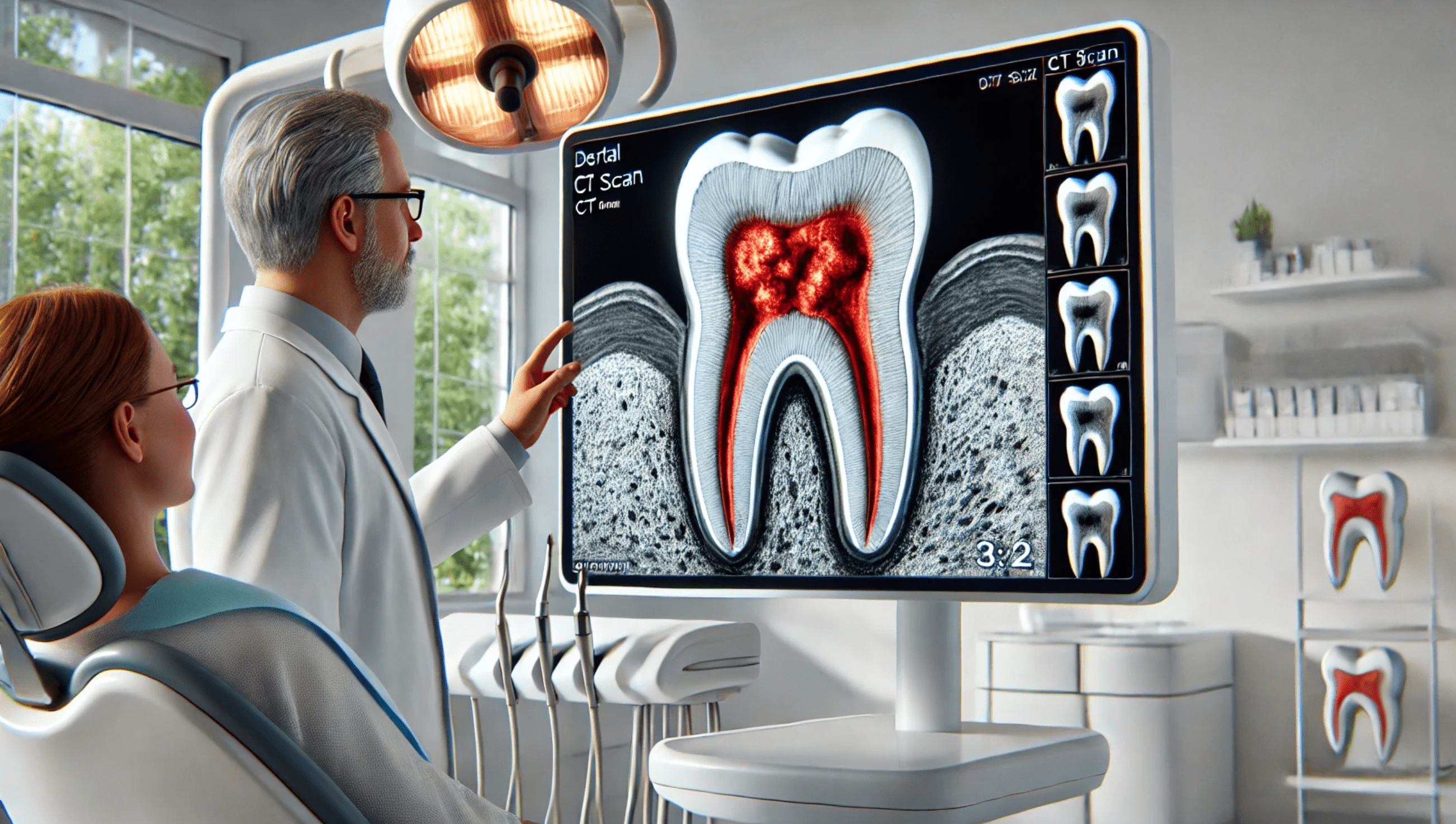
It happens that the tooth looks absolutely healthy: smooth crown, absence of caries, normal color. However, an active inflammatory process can occur inside — periodontitis. This disease affects the tissues around the root of the tooth, the periodontium, and is accompanied by a number of unpleasant symptoms.
How to recognize periodontitis:
- Pain when biting, especially on solid food;
- The feeling that the tooth has become "longer" — it interferes with the closing of the jaws;
- Swelling and redness of the gums near one tooth;
- Bad breath and possible purulent discharge;
- Sometimes there is an increase in body temperature, general malaise.
If the inflammation lasts for a long time, a cyst forms at the tip of the root — a encapsulated purulent formation. It may be asymptomatic, but in case of exacerbation it causes acute pain, swelling, and fistulas on the gums. The cyst does not go away on its own and requires dental intervention.
Diagnosis: only X-ray or 3D tomography can accurately assess the condition of the roots and surrounding tissues. That is why it is important to consult a doctor for any pain, even if the tooth looks healthy.
5. Retinated or dystopian wisdom tooth
Pain in the area of the last tooth does not always mean that it is his fault. Often the source is a retinated wisdom tooth — that is, one that has not fully erupted or grows at the wrong angle.
What problems does an uncut wisdom tooth cause?
- Pressure on the adjacent tooth, its root and surrounding tissues;
- Gingival inflammation (pericoronaritis), formation of a hood over the tooth;
- Restriction of mouth opening, pain when chewing and talking;
- Radiating pain to the ear, temple, or lower jaw;
- Misdiagnosis — the patient treats a "healthy" tooth, and the source of the problem is nearby.
Sometimes the pain caused by a wisdom tooth mimics neuralgia or sinusitis, especially if the tooth is located in the upper row. A panoramic image (OPTG) or CT scan helps to determine the exact cause. In some cases, it is recommended to remove such a tooth, especially if it does not participate in the bite and creates a permanent focus of inflammation.
6. Trigeminal neuralgia
Not all dental pain is related to the teeth themselves. If a burning sensation, sharp shooting pain covers half of the face, is accompanied by current-like sensations and lasts from a few seconds to a couple of minutes, it may be trigeminal neuralgia.
Characteristic features:
- Sharp, throbbing pain, more often on one side of the face;
- It blows into the teeth, eye, temple, ear, neck;
- Occurs when touching, washing, talking, chewing;
- Pain attacks alternate with periods of relative rest;
- There are no dental pathologies during the examination.
This is a neurological disease that requires a comprehensive diagnosis. It is important to rule out the dental cause of the pain and, upon confirmation of the diagnosis, consult a neurologist to prescribe medication or physiotherapy.
7. Sinusitis or sinusitis
Pain in the upper teeth may be a consequence of inflammation of the maxillary sinuses. Anatomically, the roots of the upper molars and premolars are located very close to the bottom of the sinuses, so any inflammation in this area can radiate into the teeth.
When to suspect sinusitis:
- Dull, aching pain in several upper teeth at the same time;
- The pain increases when the head is tilted forward;
- Accompanied by nasal congestion, runny nose, headache;
- Feeling of pressure under the eyes and in the cheekbone.
8. Hypothermia or cold
It happens that after a long stay in the cold, draft, or against the background of a viral infection, a person notices that one or more teeth begin to ache. This can be caused by the following mechanisms:
- Constriction and expansion of blood vessels under the influence of cold — this affects the nutrition of the pulp;
- Swelling of the mucous membrane and pressure on the roots of the teeth;
- Exacerbation of latent inflammatory processes with decreased immunity;
- Irritation of the trigeminal nerve, especially with herpes infection.
Such pain is easily confused with the initial stage of caries or pulpitis, but when the temperature normalizes and the inflammation is relieved, it disappears. If the pain persists, you should definitely consult a dentist.
Which examinations will help to find out the cause?
If the tooth hurts, but there is no caries, you should not try to diagnose yourself on your own. At the Smile Factor Clinic in Dubai, we provide comprehensive diagnostics, including:- visual and instrumental examination;
- X—ray or CT scan;
- tooth sensitivity testing;
- assessment of bite and TMJ function;
- consultation of related specialists - orthodontist, therapist, neurologist.
Why is it important not to delay treatment?
Toothache is always the body's signal of a problem. Even if the tooth looks healthy visually, the inflammation may be hidden inside the tissues or transmitted from neighboring structures. Delaying a visit to the dentist can lead to:
- development of chronic pulpitis or periodontitis;
- purulent inflammation and swelling of the face;
- tooth loss;
- complications due to decreased immunity.
Prevention of toothache without caries
In order not to encounter unexpected pain, it is important:
- undergo a routine check-up every 6 months;
- remove plaque and tartar;
- use soft brushes and proper cleaning techniques;
- do not self-medicate and do not delay a visit to the doctor at the first symptoms;
- take X—rays regularly - they help to identify hidden inflammations at an early stage.
The Smile Factor — when it's important to be confident
If you feel pain in your tooth, but you don't see caries, don't ignore the symptom. At the Smile Factor in Dubai, we know how important it is to accurately and quickly identify the cause of pain. Our dentists perform comprehensive diagnostics, use digital technologies, and solve problems carefully and painlessly, from sensitivity to deep pathology.
Book a consultation.
Don't put off taking care of your smile.
Contact us by phone
+971 58 524 4003
WhatsApp
Online booking
Special offer!
Free dental consultation!

The Factor Smile clinic has a special offer for new patients - a free consultation with a dentist. Depending on the problem you are contacting us with, you can get a consultation from the following specialists: therapist, surgeon, orthopedist, orthodontist.
CONSULTATION INCLUDES:
-

Professional examination by a highly qualified doctor.
-

Treatment plan
Based on the results of the examination, an individual plan will be created for you with detailed information on the stages of treatment and an indication of the current cost.
Book a consultation.
Don't put off taking care of your smile.
Contact us by phone
+971 58 524 4003
WhatsApp
We use cookies!
We use cookies to make the site convenient to use. More detailed information can be found in privacy policy.Accept