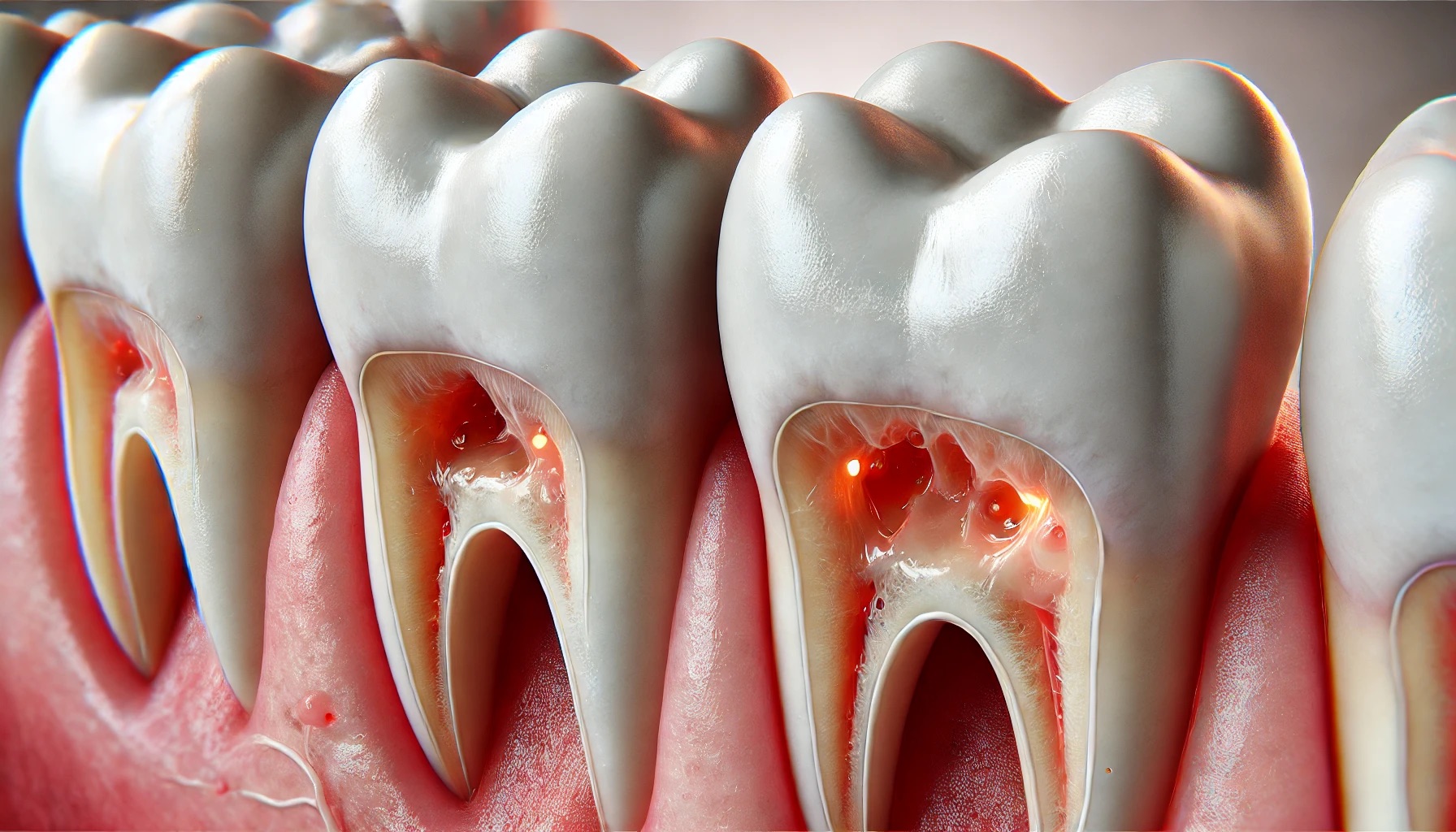
Why Interdental Caries Develops Faster Than Surface Caries
Interdental caries is one of the most insidious forms of enamel damage. It develops much faster than caries on the chewing or front (vestibular) surfaces and often remains hidden for a long time. Patients frequently ask how fast caries develop, how caries progress, and why the space between teeth is considered a high-risk zone. The answer lies in the anatomical structure of the tooth, enamel characteristics, and the challenges of cleaning these areas.
Features of the Interdental Space
Interdental spaces are narrow zones where the side surfaces of the teeth are in close contact. This is why caries on the contact surface, the side surface, or between two teeth progresses more rapidly: almost no saliva reaches this area, so natural protection is minimal. Enamel in these zones is thinner and less mineralized, making it more vulnerable to acid and demineralization. Even a small amount of plaque in this area quickly turns into an aggressive acidic environment.
Why Interdental Areas Decay Faster
Interdental caries progresses rapidly for three main reasons:
- Thin enamel in the contact area loses minerals faster and is less resistant to acid.
- Lack of natural self-cleaning: saliva cannot wash the side surfaces, so plaque remains longer.
- Hygiene challenges: a toothbrush cannot reach the side walls of the teeth, especially the front teeth — hence the high frequency of caries between anterior teeth.
As a result, caries on the surface of the tooth in the interdental zone progresses several times faster than on chewing surfaces or the front surface of the tooth.
Symptoms of Interdental Caries
The biggest problem is that symptoms appear late. At an early stage, patients usually feel nothing, and the caries are not visible.
Possible signs include:
- mild sensitivity to cold;
- pulling or aching sensations when food gets stuck;
- a dark shadow between teeth;
- bad breath caused by deep plaque;
- tartar formation in hard-to-reach areas.
Once symptoms are noticeable, the process has usually already entered the dentin layer.
Pain: When It Appears and What It Means
Pain indicates that the destruction has progressed beyond the superficial enamel and has reached the dentin — the more sensitive inner layer. At this stage, the cavity deepens, bacterial toxins irritate nerve endings, and the tooth begins to react to pressure, sweets, temperature, or tight contacts. This pain is a warning signal: the process is advancing, and delaying treatment increases the risk of pulpitis and the need for more complex procedures.
Visual Changes
In the early stages, interdental caries develop silently: the lesion forms beneath the contact point while the outer enamel looks unchanged. Patients rarely notice early signs such as slight darkening, matte spots on the side surfaces, or tiny changes near the contact area on front teeth.
Dentists, however, easily detect it — caries on the contact surface are clearly visible with transillumination or on an X-ray, both of which help show how caries form beneath the enamel.
Why Interdental Caries Is Dangerous
The main danger is the speed and spread: interdental caries destroy two adjacent tooth walls at once, leading to deeper cavities and gum inflammation between teeth. Without treatment, the process quickly reaches the dentin, increasing the risk of fractures and large structural defects. When caries affects front teeth, this is especially critical — aesthetics suffer immediately, and treatment often becomes more complex.
Early dental visits and examinations allow the dentist to determine the current stage of decay and choose the correct treatment method.
Table: Early vs Late Detection of Interdental Caries
| Detection Stage | Consequences | Treatment |
|---|---|---|
| Early detection (enamel only) | No cavity yet, surface preserved, demineralization is reversible. | Remineralization therapy, hygiene control, preventive monitoring. |
| Intermediate stage (dentin involved) | Cavity formation, destruction of the side wall, food impaction between teeth. | Filling with careful restoration of the contact surface and shape. |
| Late detection (deep caries) | Extensive destruction, high risk of pulp involvement and pain. | Deep caries treatment, possible pulp protection or endodontic therapy. |
| Very late stage | Loss of support, crown fractures, infection, risk of tooth loss. | Complex restoration with onlays or crowns; sometimes extraction and further prosthetics or implantation. |
What to Do Before Treating Interdental Caries
Before beginning treatment, it is important to examine not only the interdental space but the entire mouth. Patients often misinterpret pain and assume the problem comes from another area — for example, thinking sensitivity is caused by chewing-surface decay when the actual issue lies between teeth.
Therefore, the dentist performs a professional cleaning, removes tartar, takes an X-ray, and evaluates gum health to exclude other hidden problems and accurately determine the treatment volume. Proper preparation ensures the most conservative and precise cavity treatment.
Prevention Recommendations
To prevent interdental caries:
- use dental floss daily;
- use an irrigator;
- clean contact zones with a single-tuft brush;
- limit sticky carbohydrates;
- have professional cleanings every 6 months;
- get diagnostic X-rays at least once a year.
This is the best way to stop caries at an early stage.
How Caries Between Front Teeth and Side Surfaces Is Treated
The treatment method depends on the depth of the lesion:
- surface demineralization → remineralization therapy;
- enamel caries → minimally invasive preparation;
- dentin caries → filling with precise restoration of the contact point;
- front teeth → additional aesthetic restoration;
- wall destruction → inlays or micro-restorations.
All procedures are performed under proper isolation to ensure long-lasting, accurate results.
Conclusion: Interdental Caries Is Fast, Hidden, and Dangerous
Interdental caries progress quickly because of anatomical features, thin enamel, limited saliva flow, and the difficulty of cleaning narrow contacts. It remains silent for a long time, so patients usually notice it only when it reaches an advanced stage.
Proper hygiene, regular diagnostics, and early treatment are the only reliable ways to stop the process and preserve healthy teeth.