
Composite Fillings: What They Are, How They're Placed and How Long They Last
A composite filling is a tooth-coloured filling made of resin mixed with fine glass, silica or quartz particles. The dentist removes the decay, bonds the material to the tooth in thin layers and hardens each layer with a blue curing light. Under local anaesthesia the procedure usually takes 20–60 minutes per tooth, the filling is fully hard before you leave the chair, and with good care it can serve for 10 years or more.
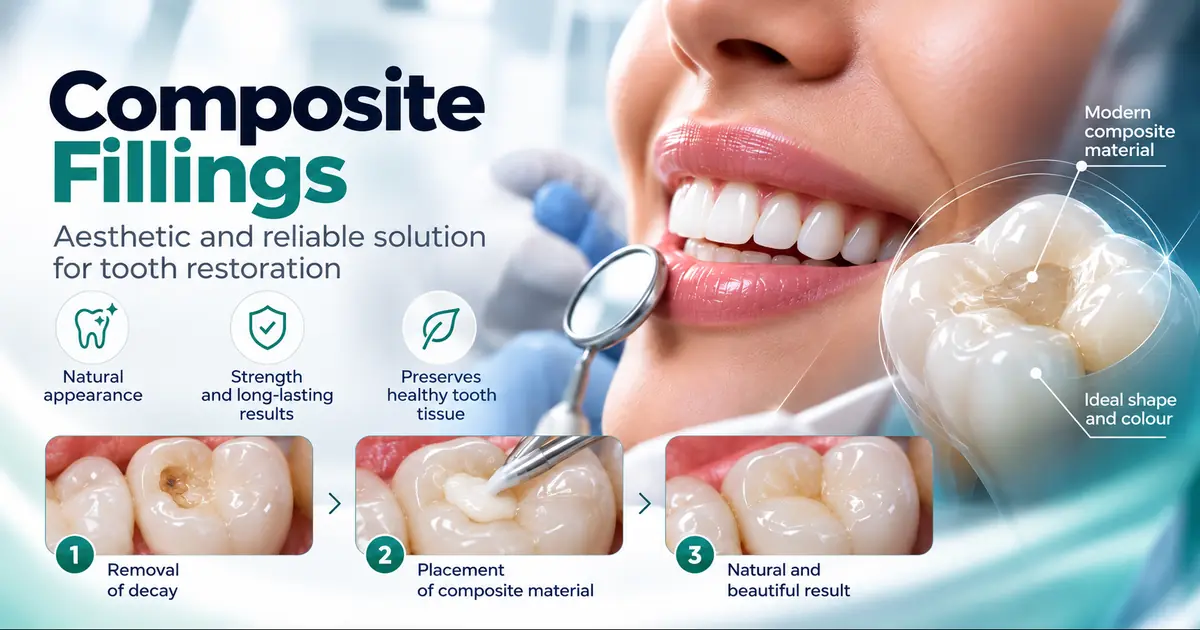
What is a composite filling?
A composite filling (also called a white filling, tooth-coloured filling or composite resin filling) restores a tooth that has been damaged by decay or a small fracture. The material has two parts: a resin base and an inorganic filler of tiny glass, silica or quartz particles. The resin makes it workable, and the filler gives it strength and resistance to wear.
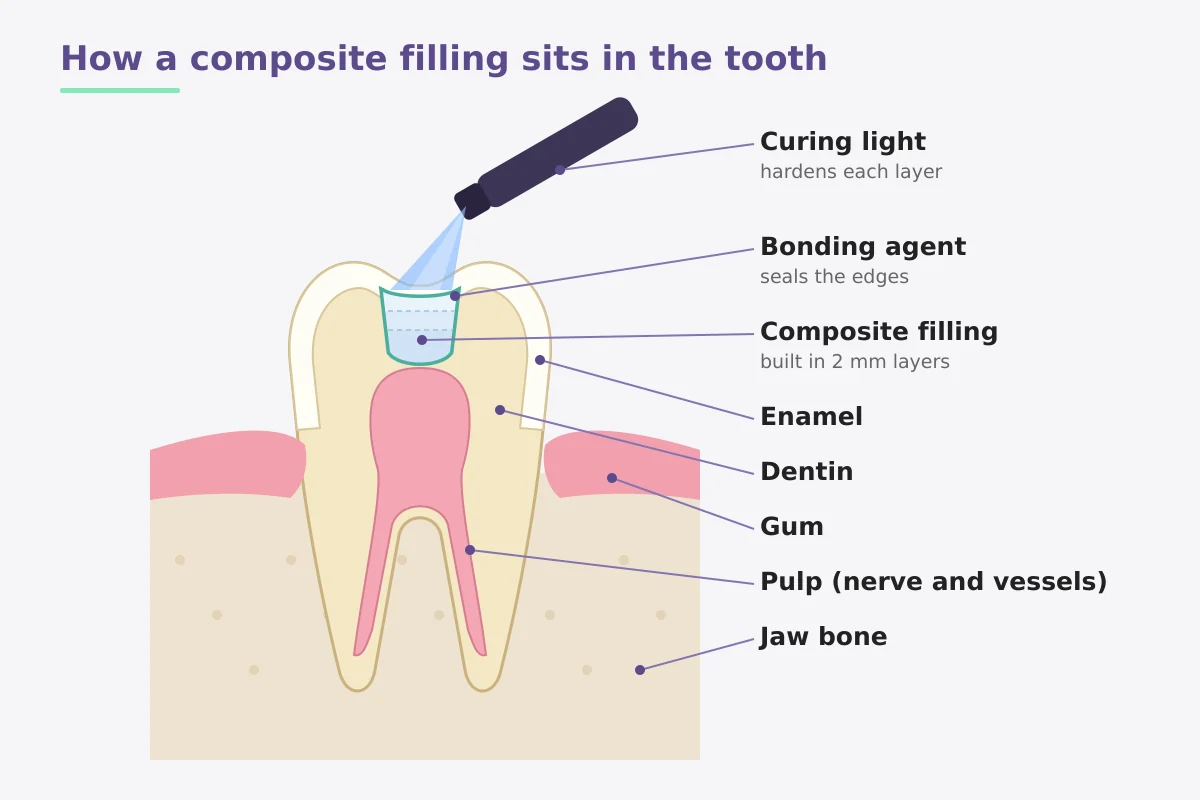
Unlike a metal filling, a composite filling is bonded to the tooth. A special adhesive locks it into the enamel and dentin, so the dentist does not need to cut extra healthy tissue just to hold the filling in place. Composite comes in many shades, so the filling can be matched to the colour of your own tooth and is hard to spot even on front teeth.
When is a composite filling the right choice?
A composite filling is the standard choice for small and medium-sized damage on both front and back teeth:
- cavities caused by tooth decay, including between the teeth;
- chipped or cracked edges and small fractures;
- replacing old, worn or leaking fillings (see why old fillings need replacing);
- cosmetic corrections of a single tooth, such as closing a small gap or restoring a worn edge.
When another option is better
- A very large cavity or thin, weak walls. A big composite filling in a molar takes heavy chewing forces and may crack. A ceramic inlay or onlay, or a crown, protects such a tooth better.
- Decay that has reached the nerve. A filling alone will not help: the tooth needs root canal treatment first.
- An area that cannot be kept dry, for example deep below the gum line. Composite bonds poorly to a wet surface, so the dentist may choose glass ionomer instead.
- Heavy teeth grinding. Fillings wear faster; your dentist may suggest a night guard or a stronger restoration.
How a composite filling is placed: step by step
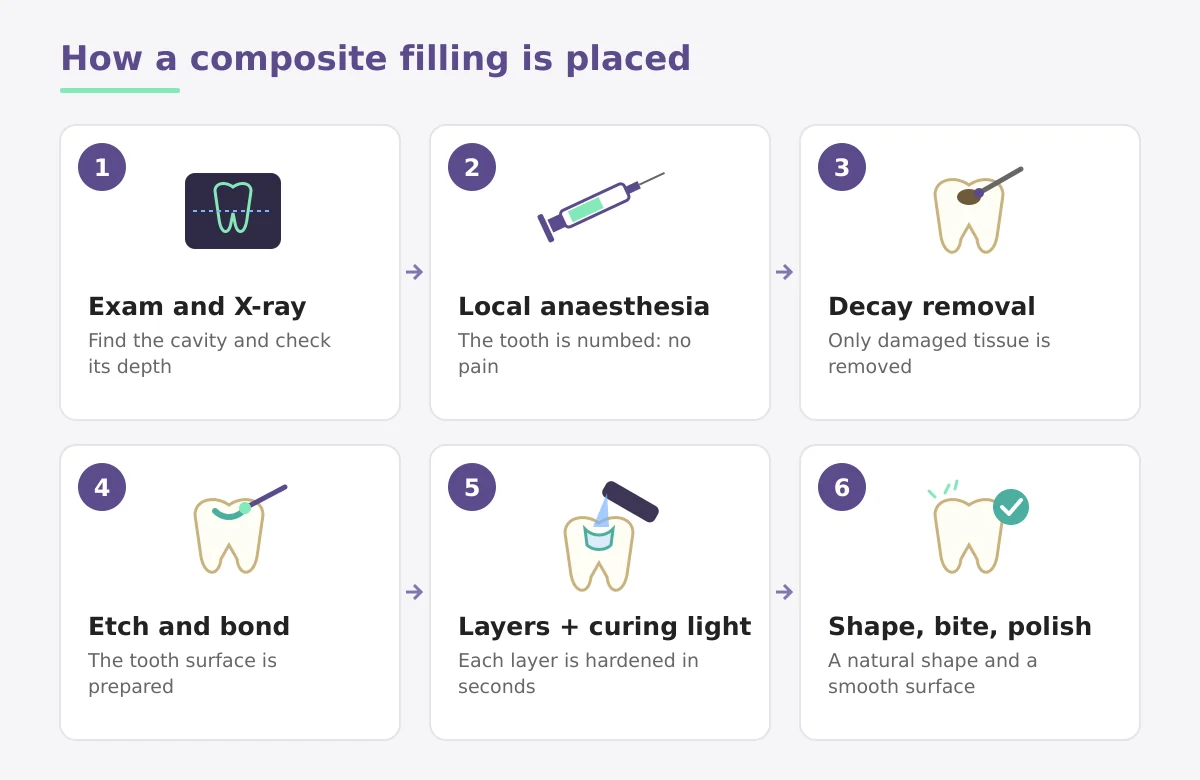
- Examination and X-ray. The dentist checks how deep the decay goes and whether the nerve is involved, and explains the options before starting.
- Local anaesthesia. The tooth is numbed, so the treatment is painless. If you feel anything, tell the dentist and more anaesthetic can be given.
- Decay removal. Only damaged tissue is removed. Leaving decay behind would let the cavity keep growing under the filling.
- Isolation. The tooth is kept clean and dry, often with a thin rubber sheet (rubber dam). This is essential for a strong bond.
- Etching and bonding. A mild gel prepares the surface, then an adhesive is applied and cured. It seals the edges of the future filling.
- Layering and curing. The composite is placed in thin layers, usually up to about 2 mm each, and every layer is hardened with the curing light in seconds. Layering reduces shrinkage stress and gaps at the edges.
- Shaping, bite check and polishing. The dentist sculpts the natural shape of the tooth, checks your bite with articulating paper and polishes the surface so it is smooth and resists staining.
A small filling may take around 20 minutes; a larger one on a back tooth can take up to an hour. Composite takes longer to place than amalgam because each layer has to be applied and cured separately and the tooth must stay dry throughout.
Composite vs amalgam and other filling materials
| Material | Appearance | Typically used for | Visits | Key points |
|---|---|---|---|---|
| Composite resin | Tooth-coloured | Small and medium cavities, front and back teeth | 1 | Bonded to the tooth, so less drilling; needs a dry field; can stain over the years |
| Amalgam | Silver-grey | Back teeth | 1 | Very durable; contains mercury; the US FDA advises certain higher-risk groups to avoid new amalgam fillings when possible |
| Glass ionomer | Tooth-coloured, less translucent | Small cavities near the gum line, children's teeth, temporary fillings | 1 | Releases fluoride and tolerates moisture better; weaker under heavy chewing |
| Ceramic inlay or onlay | Tooth-coloured | Large cavities in back teeth | 1–2 | Made in a lab or with CAD/CAM; the strongest aesthetic option; costs more |
| Gold inlay | Gold | Back teeth | 2 | Extremely long-lasting; clearly visible |
A detailed comparison is in our article on types of dental fillings. If you already have amalgam fillings in good condition, removing them "just in case" is not recommended: drilling them out releases more mercury vapour than leaving them alone. Read more about dental amalgam.
Pros and cons of composite fillings
Advantages
- Natural look: the shade is matched to your tooth.
- More healthy tooth tissue is preserved, because the filling is bonded rather than held by shape.
- Bonding supports the remaining tooth walls.
- Suitable for front and back teeth.
- No mercury.
- Hardened immediately: you can chew once the numbness wears off.
- Small chips can usually be repaired without replacing the whole filling.
Limitations
- Technique-sensitive: quality depends on keeping the tooth dry and on careful layering.
- Takes longer to place than a metal filling.
- Can pick up stains from coffee, tea, red wine or smoking over the years.
- Some studies show composites may need replacing sooner than amalgam, especially large fillings on molars.
- Usually costs more than amalgam.
How long do composite fillings last?
No filling lasts forever. Small and medium composite fillings that are well placed and looked after can serve for 10 years or more. The lifespan depends on:
- the size of the filling: the larger it is, the more load it takes;
- the position of the tooth: molars carry the heaviest chewing forces;
- grinding or clenching and habits like biting pens or ice;
- oral hygiene and diet: new decay at the edge is a common reason for replacement;
- how well the tooth was isolated and layered during treatment.
Signs that a filling needs attention: a dark line along its edge, a rough spot that catches floss, new sensitivity, or a chip. Check-ups every six months let the dentist spot these early and polish or repair the filling. Read why fillings fall out and how to prevent it.
After a composite filling: what to expect
- Eating. The filling is already hard. Wait until the numbness wears off so you do not bite your cheek or tongue.
- Sensitivity. Mild sensitivity to cold or to biting for one to two weeks is normal and should fade.
- Bite feels high. If the tooth feels like it touches first, come back: a quick adjustment takes a few minutes and prevents pain.
- Daily care. Brush twice a day with fluoride toothpaste, clean between your teeth every day and limit sugary snacks.
- Protect the filling. Do not bite hard objects; if you grind your teeth, ask about a night guard.
When to call your dentist
- pain that does not go away with painkillers, or a throbbing toothache;
- sharp pain to hot or cold that lingers after the stimulus is gone;
- swelling of the face or gum, or fever;
- the filling has chipped, cracked or fallen out.
Composite fillings at Factor Smile, City Walk
We start with an examination and an X-ray, explain whether a composite filling is the best option or the tooth needs an inlay or a crown, and agree the plan and the price with you before treatment. Treatment is done under local anaesthesia; our team speaks English, Russian and Arabic. See current prices or book a visit.
Frequently asked questions
Does getting a composite filling hurt?
No. The tooth is numbed with local anaesthesia before treatment. You may feel pressure and vibration, but not pain. If you feel any discomfort, tell the dentist.
How long does a composite filling take?
Usually 20 to 60 minutes per tooth, depending on the size and position of the cavity.
Can I eat right after a composite filling?
Yes. A composite filling is fully hardened by the curing light before you leave. Wait until the numbness wears off so you do not bite your cheek.
Are composite fillings suitable for back teeth?
Yes, for small and medium cavities. For very large cavities in molars, a ceramic inlay, onlay or crown is usually more durable.
Which is better: composite or amalgam?
Composite looks natural, preserves more tooth tissue and contains no mercury. Amalgam is very durable on back teeth but is visible and is no longer recommended for some higher-risk groups. The choice depends on the size and location of the cavity; your dentist will explain the options.
Will a composite filling change colour? Can it be whitened?
Over the years it can pick up surface stains from coffee, tea or smoking; polishing at check-ups helps. Whitening does not change the colour of existing fillings, so whiten your teeth before getting fillings on front teeth.
How long do composite fillings last?
Small and medium composite fillings that are well placed and looked after can serve for 10 years or more. Large fillings on molars, grinding and new decay shorten their life.
Can I get a composite filling during pregnancy?
Routine dental treatment, including fillings, is generally considered safe during pregnancy, and composite contains no mercury. Tell your dentist that you are pregnant so they can plan the timing and anaesthesia.
Sources
- Cleveland Clinic. Dental Fillings: Types, Materials & What They're For.
- American Dental Association, MouthHealthy. Composite Fillings.
- U.S. Food and Drug Administration. Dental Amalgam Fillings Recommendations.