
Best At-Home Teeth Whitening Kits: What Works, What Is Safe and When to See a Dentist
The best at-home teeth whitening kit is the one that matches your type of staining and your sensitivity. Kits based on hydrogen or carbamide peroxide change the shade of the tooth itself, while peroxide-free PAP kits (such as Onosonic whitening strips and the Onosonic whitening pen) are gentler and mainly lift surface stains from coffee, tea and smoking. For a bigger, longer-lasting change, dentist-supervised whitening with custom trays gives the most predictable result.
How do at-home whitening kits work?
Teeth darken for two reasons. Extrinsic stains sit on the enamel surface: coffee, tea, red wine, tobacco, curry and other strongly coloured foods. Intrinsic discolouration lies inside the tooth: natural shade, ageing, old trauma, certain antibiotics taken in childhood or fluorosis. Surface stains respond to almost any whitening product; deeper discolouration needs an agent that can pass through the enamel.
Three active ingredients do most of the work in today's kits:
- Hydrogen peroxide (HP) breaks down quickly and oxidises the coloured molecules inside the tooth. It is the strongest and fastest agent and the standard in professional whitening.
- Carbamide peroxide (CP) releases hydrogen peroxide slowly, roughly a third of its weight. It is gentler, which is why it is used in dentist-made trays worn for an hour or overnight.
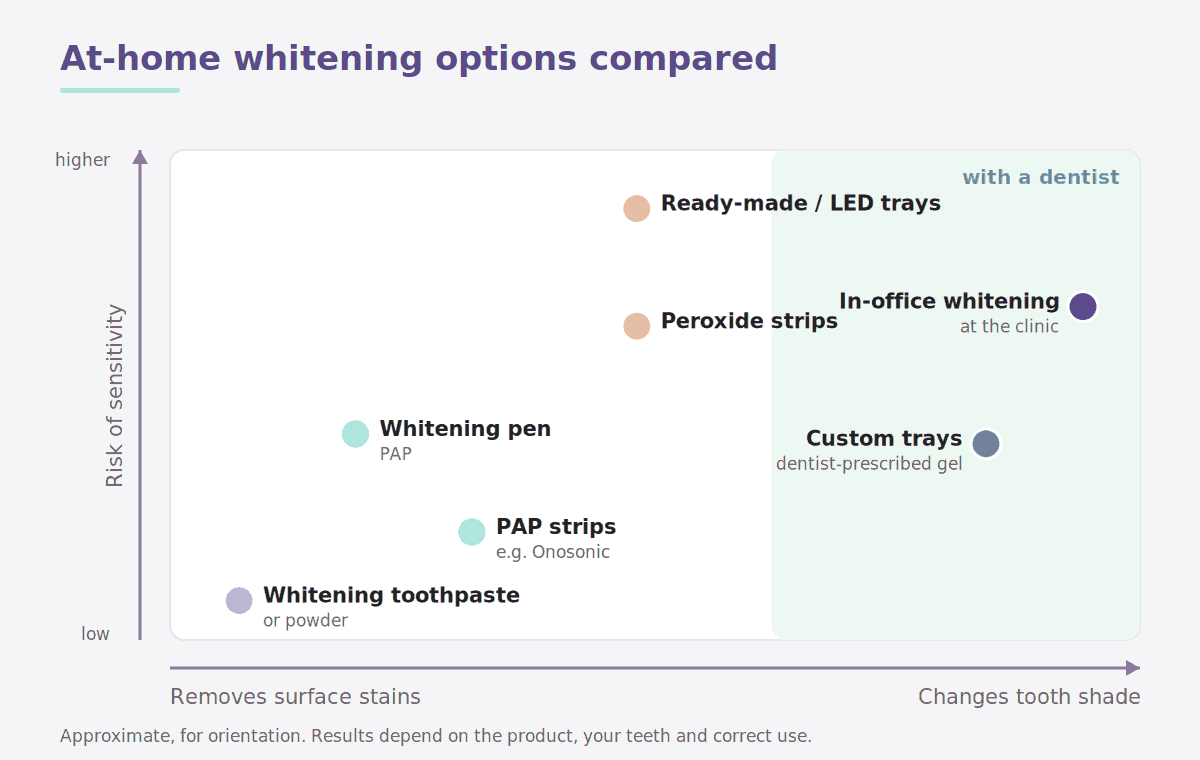
- PAP (phthalimidoperoxycaproic acid) is a peroxide-free oxidiser used in many newer "no-sensitivity" products. In a 2023 laboratory study comparing over-the-counter agents, hydrogen peroxide produced the greatest colour change; PAP left the enamel surface unchanged, but its effect was mainly stain removal rather than further whitening.
In practice this means: PAP products are a comfortable way to remove recent stains and keep teeth bright, while a real shade change of several tones still comes from peroxide used correctly.
Types of at-home teeth whitening kits
Whitening strips
Thin flexible strips coated with whitening gel that you press onto the front surfaces of the teeth, usually for 30 minutes a day over one to two weeks. They are easy to use and cover the visible part of the smile well. Their limits: the gel does not reach between the teeth or into deep grooves, and crowded or rotated teeth whiten unevenly.
Whitening pens
A pen with a brush tip that paints a thin layer of gel onto individual teeth. Pens are compact and handy for travel and touch-ups after coffee, but the gel layer is thin and stays on the tooth only briefly, so on their own they rarely change the overall shade.
LED kits and ready-made trays
A mouthpiece filled with gel, sometimes with a blue LED light. Ready-made trays fit approximately, so gel can pool on the gums in some places and miss the tooth in others. The light is mostly a marketing feature: the active ingredient and contact time matter far more.
Custom trays from a dentist
Trays made from a scan or impression of your teeth hold the gel evenly against every tooth and keep it away from the gums. Combined with a professional gel prescribed after an examination, this is the most effective and predictable way to whiten at home.
Whitening toothpastes and powders
These polish away surface stains and help maintain the result. They do not change the shade of the tooth itself and are best seen as maintenance, not treatment.
Onosonic whitening strips: what to expect
Onosonic is an oral-care brand from Dubai. According to the brand, its whitening strips use a peroxide-free PAP+ formula and are applied once a day for 30 minutes over a 14-day course, with no eating or drinking while they are on. At the time of writing the brand sells the kit online for about AED 119.
From a dentist's point of view, PAP strips are a reasonable choice if you:
- mainly have fresh surface stains from coffee, tea or smoking;
- have sensitive teeth and could not tolerate peroxide strips before;
- want to keep your smile bright between professional cleanings.
Keep expectations realistic: based on the available research, PAP removes stains rather than lightening the natural colour of the tooth. The product page does not list the concentration of the active ingredient, so results are hard to compare with peroxide kits. If your teeth are yellow by nature or have grey or brown discolouration, strips of any brand will not give the result of professional whitening.
Onosonic whitening pen: when it makes sense
The Onosonic whitening gel pen uses the same peroxide-free PAP+ gel, applied with a brush tip to the teeth you want to brighten. It works best as a touch-up: after a cup of coffee at work, before an event, or to maintain the result after whitening. Like any pen, it will not whiten a whole smile on its own, because the thin gel layer has little contact time with the enamel.
How to choose an at-home whitening kit
| Your situation | Suitable option | What to keep in mind |
|---|---|---|
| Fresh stains from coffee, tea or smoking | PAP strips or pen, whitening toothpaste | Start with a professional cleaning; repeat the course as needed |
| Sensitive teeth | PAP products or a low-concentration carbamide gel in custom trays | Use a desensitising toothpaste, whiten every other day if needed |
| Naturally yellow teeth, ageing | Peroxide gel in custom trays prescribed by a dentist | Expect a gradual change over 2 weeks |
| Grey or brown discolouration, a single dark tooth | Examination first | May need internal whitening, a veneer or a crown |
| Fillings, crowns or veneers on front teeth | Plan with a dentist | Restorations do not whiten and may need replacing to match |
Is at-home whitening safe?
Used as instructed, whitening products are considered safe for healthy teeth. The most common side effects are temporary sensitivity and gum irritation, which usually pass within a few days after stopping. Problems come from overuse, gel left on too long, ill-fitting trays and products bought from unverified sellers.
For context, in the European Union and the United Kingdom whitening products that contain or release more than 0.1% hydrogen peroxide may only be supplied through dental professionals, the first use must be supervised by a dentist, and they must not be used on anyone under 18. That is a good benchmark: a strong gel is a dental product, not a cosmetic.
At-home whitening is not recommended during pregnancy and breastfeeding, with untreated decay or gum disease, exposed roots or allergy to the gel components. Children and teenagers should not use whitening kits without a dentist.
When a home kit is not enough: whitening at Factor Smile
If over-the-counter kits have not given you the shade you want, or you want a predictable result in one go, a dentist can choose the right method after examining your teeth. At our City Walk clinic we offer:
- Professional cleaning before whitening to remove tartar and surface stains (professional teeth cleaning);
- In-office whitening in one visit, with the gums protected and a remineralising gel applied afterwards;
- Home whitening with custom trays made for your teeth, with a professional gel and a clear schedule;
- A combined course, in-office whitening followed by custom trays for the longest-lasting result.
Details, current prices and the whitening system we use are on the teeth whitening page. Planning fillings or veneers on front teeth? Whiten first, so the new restorations can be matched to your whitened shade (see composite fillings).
How to make the result last
- Brush before applying gel or strips, not straight after, and dry the teeth for better contact.
- For 48 hours after each session avoid coffee, tea, red wine, cola and smoking: freshly whitened enamel picks up colour more easily.
- Have a professional cleaning every 6 months and use your trays for a short top-up when the shade starts to fade.
- Do not exceed the number of applications in the instructions; more is not whiter, only more sensitive.
Frequently asked questions
What is the best at-home teeth whitening kit?
There is no single best kit for everyone. For surface stains and sensitive teeth, a peroxide-free PAP kit is comfortable; for a real change of shade, a peroxide gel in custom trays prescribed by a dentist works best.
Do Onosonic whitening strips work?
They use a peroxide-free PAP+ formula. Research on PAP shows it removes surface stains well and is gentle on enamel, but it whitens less than hydrogen peroxide. They suit coffee and tea stains and sensitive teeth better than naturally yellow teeth.
Is a whitening pen enough to whiten my teeth?
Usually not. A pen applies a thin layer of gel for a short time, so it is best for touch-ups and maintenance rather than full whitening.
How many shades whiter can I get at home?
It depends on your starting shade and type of staining. Stain-removing products restore your natural shade; peroxide gels in custom trays can lighten teeth by several shades over about two weeks.
Will whitening work on my fillings, crowns or veneers?
No. Whitening only affects natural enamel. Existing fillings, crowns and veneers keep their colour and may need to be replaced to match your new shade.
Can I whiten my teeth if they are sensitive?
Often yes, with a gentler product, shorter or less frequent sessions and a desensitising toothpaste. A dentist should first rule out decay, cracks or exposed roots as the cause of sensitivity.
How long do at-home whitening results last?
Usually several months to a year, depending on diet, smoking and oral hygiene. Regular cleanings and short top-up courses keep teeth bright.
Sources
- Müller-Heupt L. K. et al. Effectiveness and Safety of Over-the-Counter Tooth-Whitening Agents Compared to Hydrogen Peroxide In Vitro. International Journal of Molecular Sciences, 2023.
- General Dental Council. Tooth whitening position statement.
- American Dental Association, ADA News. When to whiten teeth.
- Onosonic. Whitening Strips: product page and directions for use.