Bone shrinks
Without a root to stimulate it, the jawbone at the gap gradually loses volume — and later may need grafting before an implant can be placed.


Dental implants replace missing teeth with a titanium root and a crown that looks and works like a natural tooth. At Factor Smile in City Walk, oral surgeons plan every implant in 3D on a CT scan and place it through a surgical guide — from a single tooth to a full arch.
Medically reviewed by Dr. Maria Gerasimova, Implantologist & Oral Surgeon · Last reviewed: September 2026


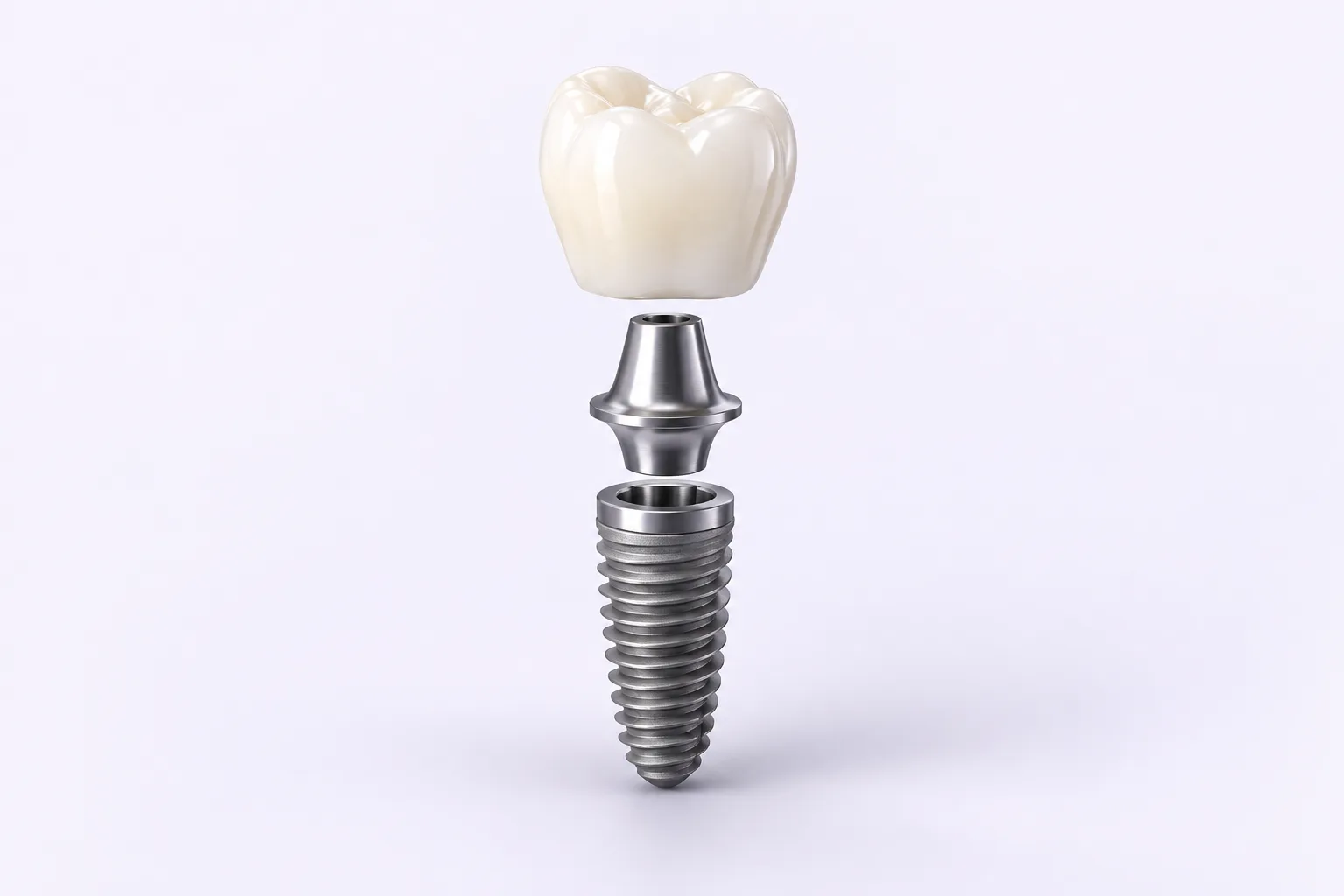
A dental implant — often called a tooth implant — replaces the root of a missing tooth. It is a small titanium screw placed into the jawbone. Over the following weeks the bone grows directly onto its surface — a process called osseointegration — and the implant becomes a stable anchor, just like a natural root. A new tooth is then fixed on top.
Systematic reviews report that more than 90% of implants are still functioning after 10 years. Long-term success depends on healthy gums, good hygiene, not smoking and regular check-ups.
Without a root to stimulate it, the jawbone at the gap gradually loses volume — and later may need grafting before an implant can be placed.
Neighbouring teeth tilt into the gap and opposing teeth over-erupt, which changes your bite.
With several teeth missing, the lower third of the face can lose support over the years.
Many of our patients lost a tooth back home years ago and never replaced it. Since then the bone at that spot has usually shrunk. That's why every plan starts with a 3D CT scan: it shows exactly how much bone is left and whether a standard implant is enough or grafting is needed — before you are quoted a price.
Bone volume and density — measured on your CT scan
Position of the tooth — visible front zone or chewing area
Whether an immediate (same-day) tooth is planned
Your priorities and budget — both options come with the same scope of work and warranty.
| Implant | Bridge | Removable denture | |
|---|---|---|---|
| Neighbouring teeth | Untouched | Ground down to hold the bridge | Clasps may rest on them |
| Jawbone | Preserved by the implant | Continues to shrink under the gap | Continues to shrink |
| Chewing | Like a natural tooth | Close to natural | Limited, may move |
| Cleaning | Brush and floss as usual | Special floss under the bridge | Removed and cleaned daily |
| Typical lifespan | Decades with good care | Often 10–15 years | Refitting every few years |
| Upfront cost | Highest | Medium | Lowest |
A 3D scan of your jaw and an examination by the implantologist. We answer your questions and discuss options.
Digital planning of the implant position, system choice, number of visits and the final price — on paper.
Placement under local anaesthesia, guided by the digital plan. Taxi to and from the clinic is included.
The implant fuses with the bone. A temporary tooth can be fitted where needed. Control visit included. With bone grafting, healing can take 6–9 months.
A digital scan, then the abutment and final crown are fixed. Taxi included.
A check-up with X-ray and professional hygiene keep the implant and gum healthy. We remind you when it's time.
The final decision is made by the implantologist after the CT scan and a review of your medical history.
Insurance: reimbursement We don't bill insurance companies directly. You pay the clinic, and we give you everything your insurer needs to reimburse you.
Card, cash and bank transfer. If you need more information about type of payment you can send us your question or call +971 54 398 4003
The surgery is done under local anaesthesia, so you feel pressure but not pain. Afterwards most patients describe discomfort for 2–3 days, managed with standard painkillers. Swelling, if any, peaks on day 2 and settles within a few days.
With good hygiene, no smoking and regular check-ups, implants commonly last for decades. The crown on top may need replacing after many years of wear.
Usually 3–5 months from CT scan to final crown. The healing phase — while the implant fuses with the bone — takes 2–4 months; with bone grafting, 6–9 months.
Often, yes: if the implant is stable enough at placement, a temporary tooth can be fixed the same day. The implantologist decides during surgery; the final crown follows after healing.
The CT scan shows this before treatment. Bone can be rebuilt with grafting or, in the upper jaw, a sinus lift — either before or together with implant placement. The cost is included in your written plan.
Both are titanium implant systems. Nobel Biocare offers a wider range for complex anatomy, immediate loading and full-arch treatment. The implantologist recommends one after reviewing your CT.
Clinics quote different things: some give the price of the implant alone, others include the abutment, crown and surgical guide. Always ask what is included. At Factor Smile, the full cost of your treatment is set out in a written plan after the CT scan, before treatment starts.
The implant itself is rarely covered in the UAE, but the CT scan, extraction and sometimes the crown may be. We check your policy before the visit.
Yes. After surgery you can travel once the first follow-up confirms normal healing, usually within about a week. The crown stage can be planned around your trip.
Implants are placed once the jaw has finished growing, usually after 18. There is no upper age limit — general health and bone matter more than age.
At Factor Smile, current offers are a B&B implant (Italy) for AED 3,500 and a Nobel Biocare implant (Switzerland) for AED 4,900 — the implant, its placement and anaesthesia included. The abutment and crown depend on your case and are priced in the written treatment plan after the CT scan. Current prices are always on the Offers page.
The implant is designed to stay in the bone for life once it has integrated. The crown on top is a replaceable part and may need renewing after many years. Long-term success depends on hygiene, not smoking and regular check-ups.
It is uncommon. Most problems appear in the first weeks, before the implant has fused with the bone, or years later because of gum inflammation around the implant (peri-implantitis). Check-ups and professional hygiene every 6–12 months catch these early.
Implant placement is a routine, well-studied procedure. Risks are assessed in advance: the CT scan shows nerves, sinuses and bone, and the implantologist reviews your medical history before planning surgery.
Eat a light meal beforehand, take your regular medication unless the doctor advises otherwise, and tell us about blood thinners or osteoporosis medication in advance. Avoid smoking and alcohol before and after surgery. We send written instructions with your plan.