
Dental Implant Recovery Timeline: What to Expect Day by Day
Recovery after a single dental implant is shorter than most patients expect. The first 48 hours bring mild swelling and soreness that ordinary painkillers handle, most people are back at work on day two, and by day seven the area is comfortable. The implant then fuses with the jaw bone over 3–6 months, but this stage does not restrict daily life.

What affects how fast you recover
Two patients with "one implant" can have quite different recoveries. The timeline below describes a typical single implant in healthy bone. Healing takes longer or feels heavier when:
- several implants are placed at once, or a full arch is restored (All-on-4);
- a bone graft or sinus lift is done in the same surgery;
- the tooth is removed and the implant placed on the same day (same-day implants);
- you smoke, have poorly controlled diabetes or take medicines that affect bone or blood clotting.
Your surgeon will tell you which of these apply to you and adjust the instructions. Always follow the plan you received at the clinic if it differs from the general guide below.
Dental implant recovery timeline
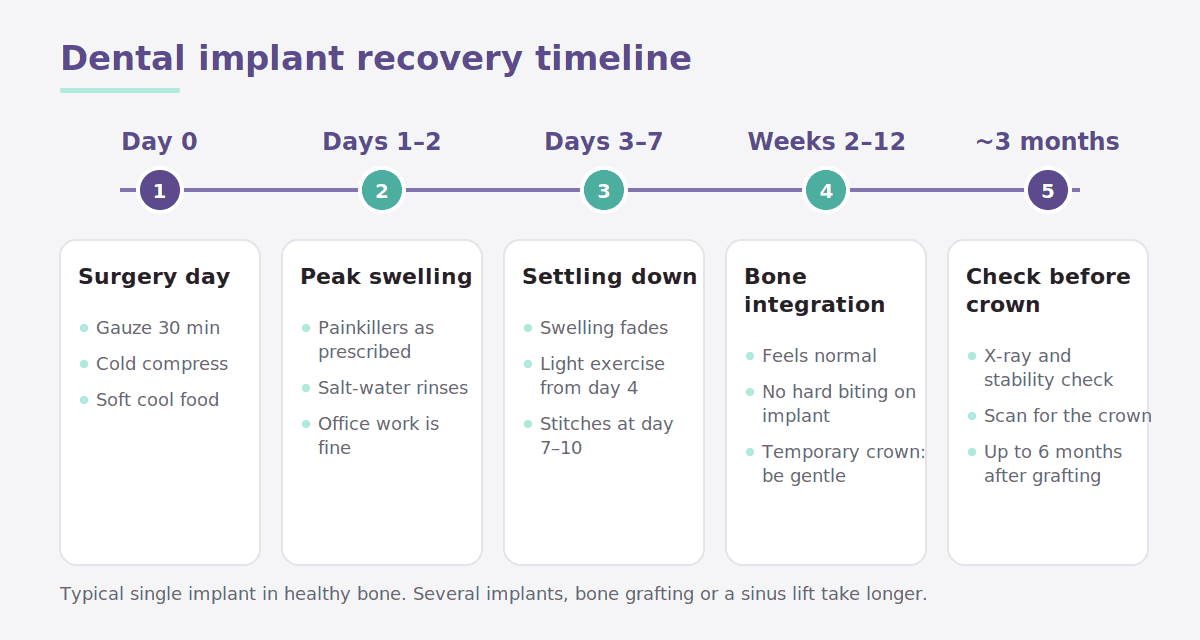
Day 0: surgery day
The anaesthetic keeps the area numb for 2–3 hours. Bite on the gauze for 30 minutes to help a blood clot form. Apply a cold compress to the cheek, 15 minutes on and 15 minutes off, for the first 4 hours. Eat only soft, cool food once the numbness has worn off, and do not rinse, smoke or drink alcohol on this day. Take the first dose of painkiller before the anaesthetic wears off, as prescribed.
Days 1–2: peak swelling
Swelling and soreness usually peak now. Paracetamol or ibuprofen as prescribed is normally enough. From day 1 you can start gentle salt-water rinses (half a teaspoon of salt in a glass of warm water) after meals, without forceful swishing. Brush your other teeth as usual and keep the brush away from the surgical site. Office work is fine; skip the gym, saunas and hot baths.
Days 3–7: settling down
Swelling fades and any bruising turns yellow and disappears. Warm soft food is fine; chew on the other side. Light exercise is possible from about day 4. Stitches are checked or removed at around day 7–10, unless they dissolve on their own.
Weeks 2–12: bone integration
The gum has healed and the area feels normal, but the implant is still fusing with the bone. This process, called osseointegration, is what makes an implant as stable as a natural root. Avoid biting hard food directly on the implant. If a temporary crown or bridge was fitted, treat it gently and chew on the other side.
Around 3 months: check before the crown
Do not skip this visit. The dentist checks the stability of the implant and the gum, usually with an X-ray, and only then takes a scan or impression for the permanent crown. In the upper jaw or after bone grafting this stage may come later, closer to 6 months.
What to eat after implant surgery
| Period | What you can eat | What to avoid |
|---|---|---|
| Day 0 | Cool soft food: yoghurt, smoothies (with a spoon), cold soup, mashed potatoes | Hot food and drinks, alcohol, anything crunchy |
| Days 1–3 | Warm soft food: porridge, scrambled eggs, soup, pasta, fish, hummus | Spicy and very hot food, nuts, seeds, chips |
| Days 4–14 | Most normal food cut small, chewing on the other side | Hard, sticky and crunchy food on the implant side |
| Weeks 2–12 | Normal diet | Biting hard items (ice, nuts, bones) directly on the implant or temporary crown |
What is normal and when to call us
Normal: mild bleeding or pink saliva for the first day, swelling that peaks on day 2–3, a dull ache that steadily decreases, slight bruising on the cheek, a small bump of gum over the implant.
You can reach us by phone or WhatsApp; the contacts are on the contacts page.
Tips for a smooth recovery
- Do not smoke. Smoking reduces blood flow to the gum and bone and is one of the main reasons implants fail to integrate. Stop at least for the first weeks, ideally for good.
- Sleep with your head raised on an extra pillow for the first two nights to reduce swelling.
- Keep the area clean but gentle: soft brush, salt-water or prescribed rinses, no water flosser on the site until the dentist allows it.
- After a sinus lift, do not blow your nose and sneeze with your mouth open for two weeks, and avoid flying and diving until the surgeon allows it.
- Take medicines exactly as prescribed, including the full course of antibiotics if you were given them.
- Come to every follow-up visit. Most problems that are caught early are easy to solve.
Planning treatment? Read how the process works on our dental implants page or meet our implantologist, Dr. Maria Gerasimova.
Frequently asked questions
Can I go to work the day after implant surgery?
Usually yes. Most patients with a single implant return to office work the next day. Plan a day or two off after several implants or a bone graft, and avoid heavy physical work for the first week.
How long does pain last after a dental implant?
Soreness typically peaks in the first 48 hours and then decreases every day. By day 5–7 most people no longer need painkillers. Pain that gets worse after day 3 is a reason to call the clinic.
When can I eat normally after an implant?
Soft food for the first few days, then most normal food cut small from around day 4, chewing on the other side. Avoid biting hard food directly on the implant until the permanent crown is fitted.
When can I exercise after implant surgery?
Light activity such as walking from day 1–2, light exercise from about day 4, and intense training after the first week if healing is going well. Ask your surgeon if you had a bone graft or several implants.
How long does it take for an implant to fuse with the bone?
Usually 3–6 months. The lower jaw tends to heal faster than the upper jaw, and bone grafting adds time. The dentist confirms integration before fitting the permanent crown.
Can I smoke after getting an implant?
It is strongly advised not to. Smoking slows healing and increases the risk that the implant will not integrate. Avoid it at least during the first weeks.
Is recovery different after All-on-4 or same-day implants?
Swelling can be more noticeable because more of the jaw is involved, and you follow a soft-food diet for longer to protect the temporary teeth. Your surgeon will give you a specific plan.
Sources
- Cleveland Clinic. Dental Implants: What They Are, Procedure & Recovery.
- Contemporary Concepts in Osseointegration of Dental Implants: A Review. PubMed Central.